MERKABA CODEX LUX
The Codex LUX
An architecture of order, knowledge, and reality
MERKABA CODEX LUX
The Codex LUX does not begin with a claim, but with an experience familiar to every human being:
There are moments when perception becomes clear. Moments in which things seem to fall into place without conscious effort. Moments in which orientation does not need to be constructed, but simply appears.
The Codex LUX takes this experience seriously and asks a simple question:
If reality does not merely appear random, but can also be perceived as structured — how can this structure be described without distorting it?
The Codex LUX proposes a framework of order for this purpose.
It is not a belief system.
It is not an ideology.
It is not a doctrine.
It is not a closed worldview.
It prescribes nothing.
It invites observation.
Its aim is not persuasion. Its aim is readability.
Contents
1. Order of Reality
2. The Zero Point
3. The Primordial Cell
4. Primordial Cell – Structure
5. The Merkaba
6. The Basic Structure of 7
7. When Order Becomes Dynamic – The 12
8. Seven Merkabas and the 49 Primordial Cells
9. Gate 50
10. 144 – The Relational Space
11. 72 – The Membrane
12. The Torus
13. Meaning for the Reader
14. Current Development Status
15. Ethical Clarity
16. Short Form of the Overall Structure
17. Invitation
18. Questions / Contact
19. Support
2. The Zero Point
3. The Primordial Cell
4. Primordial Cell – Structure
5. The Merkaba
6. The Basic Structure of 7
7. When Order Becomes Dynamic – The 12
8. Seven Merkabas and the 49 Primordial Cells
9. Gate 50
10. 144 – The Relational Space
11. 72 – The Membrane
12. The Torus
13. Meaning for the Reader
14. Current Development Status
15. Ethical Clarity
16. Short Form of the Overall Structure
17. Invitation
18. Questions / Contact
19. Support
MERKABA CODEX LUX
ORDER OF REALITY
Reality appears to human beings in different languages:
as number,
as form,
as process,
as meaning,
as rhythm,
as relationship.
Mathematics describes relations.
Geometry describes spatial structure.
Natural science describes interactions.
Systems theory describes organization.
Language describes distinction.
Perception describes experience.
These fields are different — yet they can be compared.
The Codex LUX begins precisely at this point.
It does not merge disciplines.
It does not replace specialist fields.
It respects each domain in its own logic.
It asks only one question:
Which principles of order appear — independently of subject matter —
across several fields at the same time?
Not as proof.
But as an observation of structure.

MERKABA CODEX LUX
THE ZERO POINT

In the Codex LUX, the zero point denotes the simplest possible reference.
Mathematically, it corresponds to the origin of a coordinate system.
In systems terms, it corresponds to a stable initial state.
In terms of perception, it corresponds to the moment before interpretation begins.
The zero point is not a goal and not a state that must be achieved.
It is a point of reference from which differences become visible.
Without reference, nothing can be distinguished.
Without distinction, nothing can be recognized.
Without recognition, no order can appear.
The Codex LUX therefore uses the term zero point as a functional designation:
not as an idea, but as orientation.
MERKABA CODEX LUX
THE PRIMORDIAL CELL
As the smallest complete descriptive unit of order, the
Codex LUX
uses the term primordial cell.
It is defined as the minimal structure in which three conditions are fulfilled simultaneously:
– direction can be distinguished
– relationship becomes possible
– stability is present
Mathematically, this can be represented as six directional relations with a center.
Geometrically, it corresponds to a complete orientation in space.
In systems terms, it corresponds to the smallest unit capable of self-alignment.
The Codex LUX describes this structural form as
Primordial Cell – Structure
6 relations + 1 center = 7

MERKABA CODEX LUX
Primordial Cell – Structure
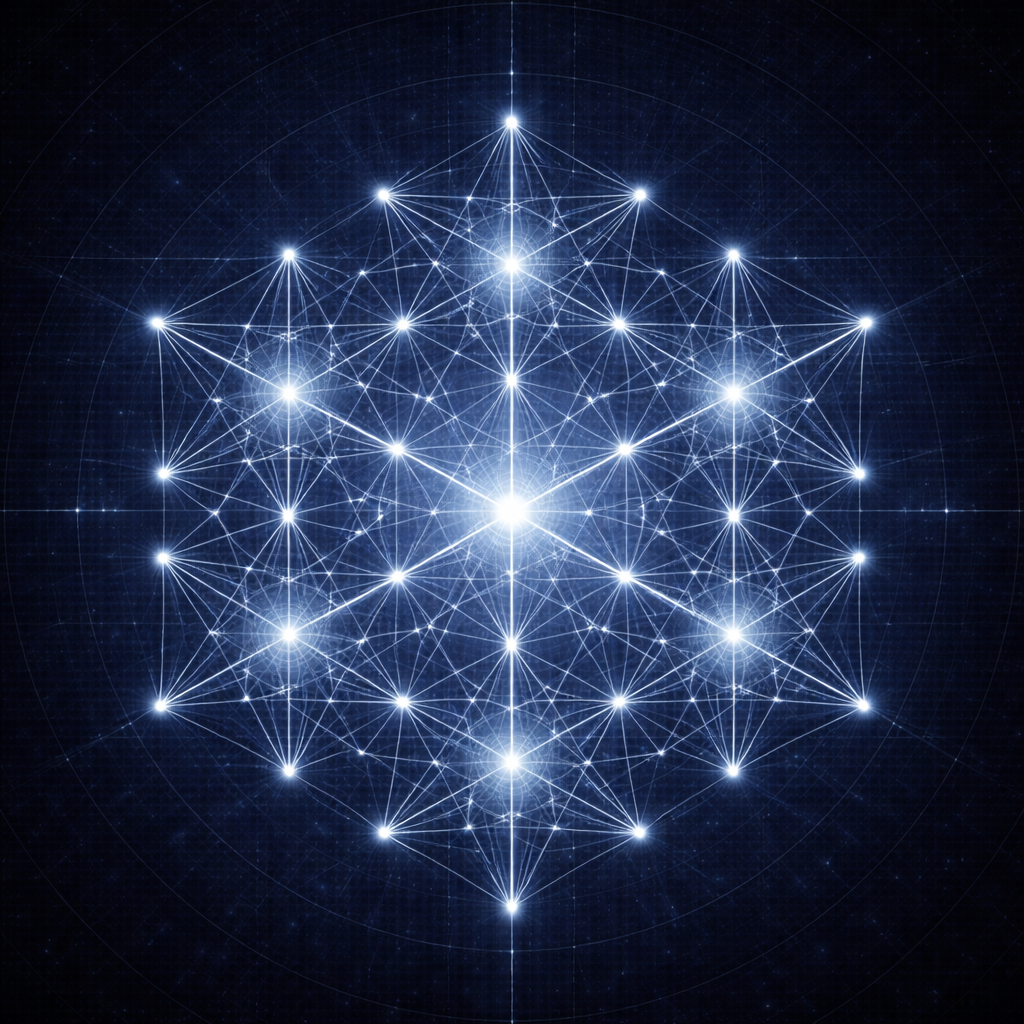
The term primordial cell is purely a
model term.
It belongs to the terminology of the Codex LUX and serves only as a structural designation within this framework.
It does not replace any biological definition.
It makes no claim to scientific exclusivity.
It does not describe a living cell in the biological sense.
The term is used solely to name a minimal complete form of order in a clear and unambiguous way.
Within the Codex LUX, it refers to the smallest structural configuration in which orientation, relation, and stability appear simultaneously.
In this sense, the primordial cell functions as a conceptual reference structure from which more complex orders can be described.
MERKABA CODEX LUX
THE MERKABA

In the
Codex LUX,
a Merkaba denotes a fully stable space of order composed of seven primordial cells.
Mathematically, this corresponds to a fully connected relational unit.
Geometrically, it corresponds to a structure with a center and symmetrical directional relations.
In systems terms, it corresponds to an organization that remains stable while it changes.
A Merkaba is not a symbol.
Not an image of belief.
Not a sign.
It is a model term describing a structure in which balance and dynamism can exist simultaneously.
The Codex LUX uses this term to designate a state in which order is neither rigid nor chaotic,
but orientable.
MERKABA CODEX LUX
THE BASIC STRUCTURE OF 7
Within the Codex LUX, the number 7 represents a complete structural form:
differentiation + center
Mathematically, it describes a minimally complete number of relations.
Geometrically, it describes a fully oriented spatial environment.
In systems terms, it corresponds to a stable organizational unit.
In the Codex LUX, the meaning of 7 does not arise from symbolism,
but from function:
it marks the smallest structure in which diversity and coherence
can exist simultaneously.

MERKABA CODEX LUX
WHEN ORDER BECOMES DYNAMIC – THE 12

As soon as a structure does not merely exist but begins to change,
orientation requires additional differentiation.
The Codex LUX describes this dynamic differentiation as 12.
Mathematically, it appears as an expansion of relations into directed axes.
Geometrically, it corresponds to a complete orientation of movement.
In systems terms, it corresponds to a structure capable of describing processes rather than static states.
In the Codex LUX, the number 12 is therefore not a symbolic motif,
but a structural model for dynamic order.
MERKABA CODEX LUX
SEVEN MERKABAS AND THE 49 PRIMORDIAL CELLS
The Codex LUX does not describe order as a single level, but as a multilayered architecture.
This architecture is represented as seven complete spaces of order — seven Merkabas.
Each of these spaces contains seven primordial cells.
Mathematically, this results in a complete field of 49 structural units.
Geometrically, it corresponds to a differentiated spatial grid.
In systems terms, it corresponds to a fully describable organizational field.
These levels are not a hierarchy.
Not a ranking.
Not an evaluation.
They are perspectives on the same reality and are documented and made accessible within the framework of the
Association.

MERKABA CODEX LUX
GATE 50

Every stable structure can harden into rigidity if it lacks a mechanism of return.
Codex LUX describes this mechanism of return as Gate 50.
Mathematically, it corresponds to a recalibration function.
In systems terms, it corresponds to self-correction.
In terms of perception, it corresponds to a return to reference.
Gate 50 is therefore not an element of structure,
but a function of structure:
the possibility of restoring orientation.
MERKABA CODEX LUX
144 – THE RELATIONAL SPACE
When orientation is fully differentiated, a relational field of maximum comparability emerges.
Codex LUX refers to this model field as 144.
Mathematically, it stands for a fully differentiated relational space.
Geometrically, for a field of maximally distinguishable positions.
Systemically, for a structure in which diversity can exist without collapsing into chaos.
The number does not denote a mystical value, but a model quantity for complete differentiability.

MERKABA CODEX LUX
72 – THE MEMBRANE

When a relational field becomes fully differentiated, a boundary naturally emerges.
Codex LUX describes this boundary as the 72-structure.
Mathematically, it appears as the paired relation of every element.
Geometrically, it corresponds to a mirror structure.
In systems terms, it corresponds to a membrane principle.
A membrane does not merely separate.
It enables exchange.
In Codex LUX, the 72 therefore denotes the function of a boundary
that allows connection while preserving structural integrity.
MERKABA CODEX LUX
THE TORUS
Many stable systems depend on feedback.
Without return flow, processes gradually lose coherence.
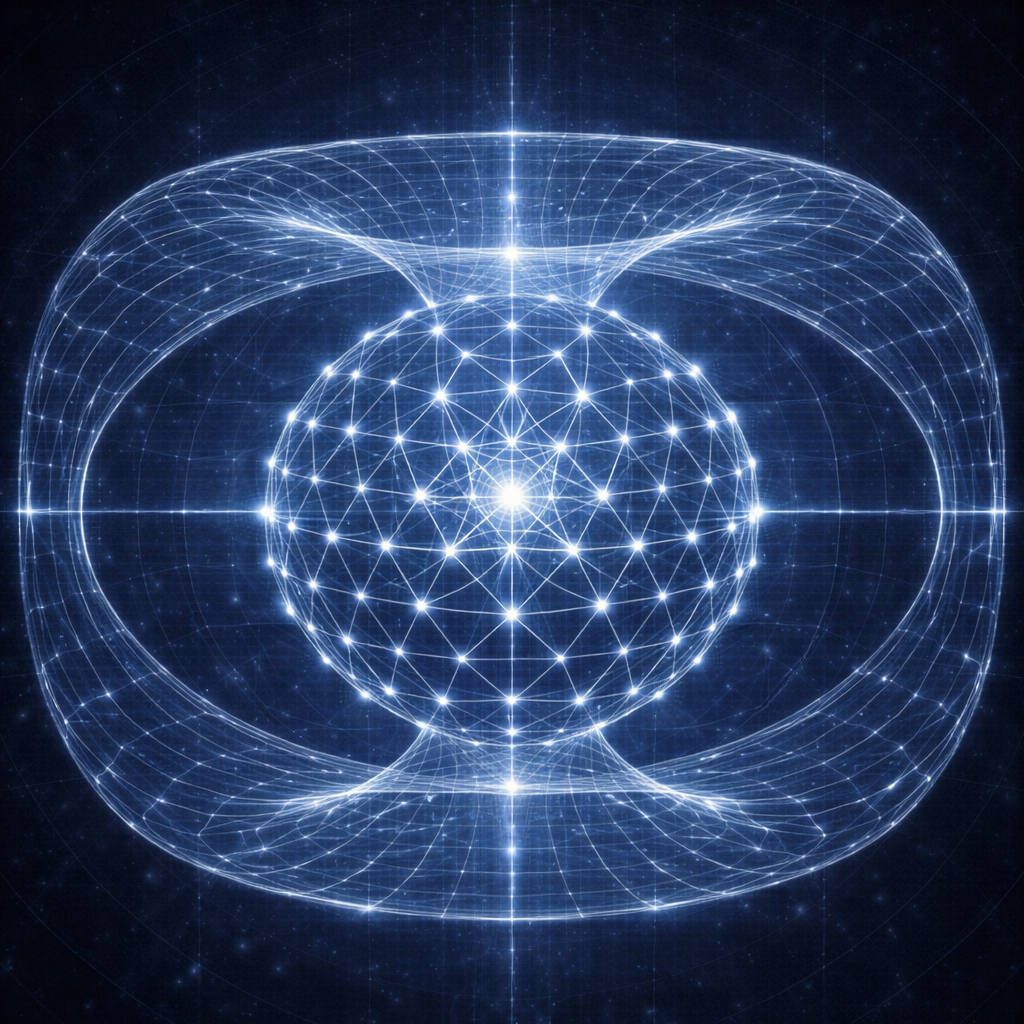
Codex LUX describes this principle of stability through the model of the torus.
Geometrically, it represents a closed form of movement.
In systems terms, it corresponds to circulating organization.
In terms of perception, it corresponds to the experience of expansion and integration.
In Codex LUX, the torus is therefore not an object,
but a functional description:
order remains stable when movement remains integrable.
MERKABA CODEX LUX
MEANING FOR THE READER
The Codex LUX is not addressed to belief.
It is addressed to perception.
It demands no agreement.
It asks only for attention.
Its proposal is simple:
If reality possesses structure,
then that structure can be recognized.
Not because someone prescribes it.
But because it can be observed.
The reader is not a follower.
The reader is a point of observation.
Not the center of the world —
but the center of his or her perception.
MERKABA CODEX LUX
Current Development Status
The Codex LUX is currently in an advanced phase of structural development. Over the past months, a comprehensive architecture has been established that connects several levels of order, analysis, and description.
The aim of the project is the development of a coherent framework of order that allows complex relationships to be described in a clearly structured form. The Codex therefore does not present itself as a single theory, but as an architecture of order and analysis that brings together different perspectives — mathematical, geometric, systemic, and informational — within a shared framework.
During the previous phases of development, the following foundations have been established in particular:
- Definition of central structural concepts such as the Zero Point, the Primordial Cell, and the Merkaba
- Description of fundamental structural numbers and reference spaces
- Development of several documentation and specification systems for describing individual structural elements
- Construction of a consistent model architecture for relationships, spaces, and dynamic processes
An important part of this work is the systematic documentation of structural classes. At present, the Codex distinguishes five fundamental levels:
- Point – reference units without extension
- Line – connections between points
- Field – organized point sets arranged in grid form
- Space – embedding of a field within dimensional context
- Flow – dynamic transitions within a space
Together these levels form a continuous transition structure:
Point → Line → Field → Space → Flow
Parallel to the conceptual development, several formal document series have already been created that define how individual structural units may be described and connected with one another. These documents form the basis for a consistent further development of the system and enable clear interpretation both by human readers and by AI-supported analytical systems.
The current stage of development focuses particularly on three areas:
- further refinement of the structural definitions
- coherence review of the existing models
- gradual publication of the material in a clear and traceable form
In parallel, a technical system architecture is being prepared that will allow the structure of the Codex to be represented digitally, navigated, and analytically explored.
The Codex LUX therefore does not present itself as a finished doctrine, but as an ongoing documentation of a structural model of order. Over time, this work may open further fields of application — for example in research, systemic thinking, visualization of complex structures, or interdisciplinary analytical environments.
MERKABA CODEX LUX
SHORT FORM OF THE OVERALL STRUCTURE
Zero Point
→ Primordial Cell
→ Merkaba
→ Seven Merkabas
→ Forty-Nine Primordial Cells
→ Gate 50
→ Dynamic Orientation
→ Relational Space
→ Membrane Structure
→ Feedback
→ Zero Point
Not a doctrine.
But a map of readability.

MERKABA CODEX LUX
INVITATION
You do not have to accept anything in order to read this text.
You do not have to believe anything in order to examine it.
If order becomes perceptible while reading,
this does not arise from the words.
It arises because structure is being recognized.
And recognition does not happen in the text.
It happens within you.
Note: The content is intended for education, research, and the exploration of consciousness. It does not contain promises of healing or success. Engagement with the material takes place under the reader’s own responsibility.
You do not have to believe anything in order to examine it.
If order becomes perceptible while reading,
this does not arise from the words.
It arises because structure is being recognized.
And recognition does not happen in the text.
It happens within you.
Note: The content is intended for education, research, and the exploration of consciousness. It does not contain promises of healing or success. Engagement with the material takes place under the reader’s own responsibility.
MERKABA CODEX LUX
QUESTIONS / CONTACT
If you have questions, if something remains unclear,
or if you would like to contribute a concrete observation,
please use the contact page.
I respond in a way that reflects the intention of this project: clearly, transparently, and without unnecessary claims.
I respond in a way that reflects the intention of this project: clearly, transparently, and without unnecessary claims.
MERKABA CODEX LUX
SUPPORT
If this work resonates with you and you would like to see it continued with care and documented publicly in a transparent and traceable way, you can support the Association and its further development.
Support here does not imply agreement, but enablement: it allows documentation, structural work, and publication to continue in a stable and open form.
Support here does not imply agreement, but enablement: it allows documentation, structural work, and publication to continue in a stable and open form.